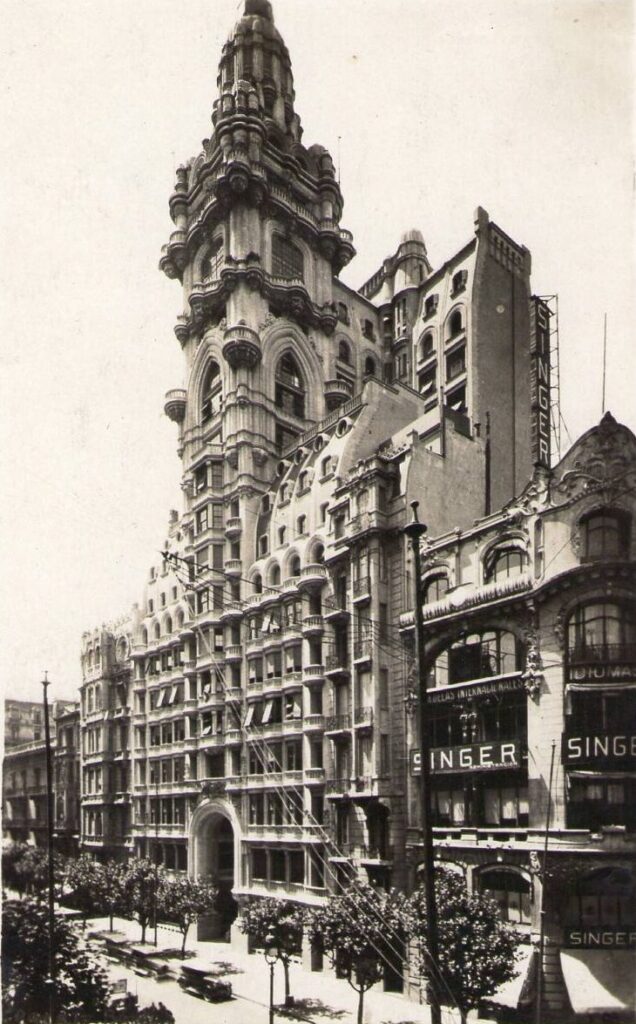
A skyscraper in Argentina’s capital takes its inspiration from The Divine Comedy.
Originally published in History Today
In the early 20th century, Italian architect Mario Palanti had a troubling vision of the future.
Having emigrated to Argentina in 1909, Palanti returned to Europe in order to enlist in the Italian army and fight in the First World War, an experience that convinced him Europe would ultimately be destroyed by even greater conflicts to come. After he returned to Argentina, he conceived a plan to rescue the remains of the Dante Alighieri, the medieval poet whom Palanti considered one of the jewels of European culture.
In 1918 Palanti met a compatriot, Luis Barolo, owner of a successful textile business (and a fellow Dante aficionado) and convinced him to finance a building for Dante’s corpse. The pair decided to make the building itself an homage to the poet. Construction on the Palacio Barolo began in 1919 and, by the time it was completed four years later, it was the tallest building in South America.
Though Dante’s remains never left the Italian city of Ravenna, the building he unwittingly inspired is a fine example of literary devotion rendered in concrete. It is divided into two blocks of 11 offices per floor (corresponding to 22, the meter used by Dante in The Divine Comedy). Vertically, the building is split into three sections, comprising Hell, Purgatory and Paradise. It stands 100m tall, mirroring the number of cantos in the poem, and visitors to the ground floor lobby pass through one of nine entrance archways, corresponding to the nine circles of hell.
A working lighthouse is located on the building’s roof, symbolising the angels to be found in paradise.
Barolo himself never lived to see the building that bears his name: he died in 1922.