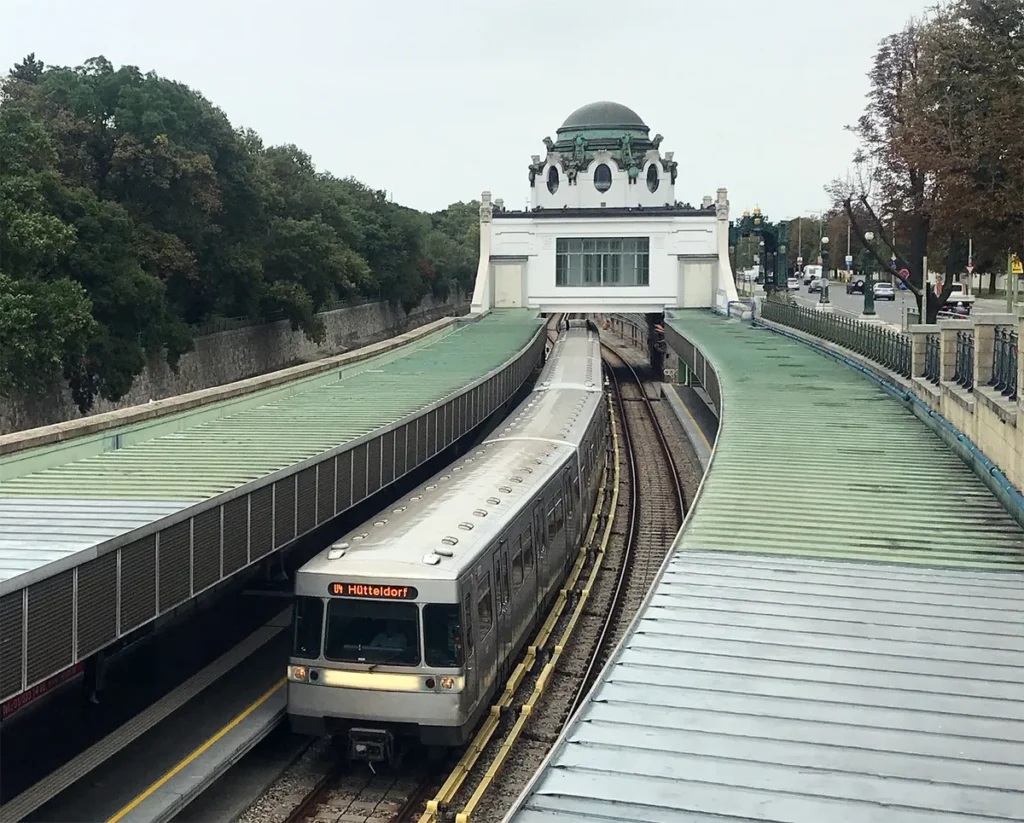
An entrance at Vienna’s Hietzing station was built specifically for the emperor.
Originally published in Atlas Obscura.
The Hofpavillon (Imperial Court Pavilion) at Hietzing station may have only welcomed Franz Joseph’s royal bootsteps on two occasions, but it remains a grand monument to transit architecture.
At the time of its opening in 1898, the Wiener Stadtbahn (Viennese City Railway) was one of the biggest transport projects in the world. The architect Otto Wagner was in charge of the Stadtbahn’s design, including the stations, and firmly believed that such a monumental undertaking needed equally impressive ground-level buildings. A founder of the Vienna Secession movement, Wagner had designed several buildings across the city but was yet to receive a royal commission. Perhaps in a bid to improve his prospects, he came up with the idea of a special pavilion and private entrance at Hietzing station, close to the emperor’s summer retreat, Schönbrunn Palace.
Wagner’s design combines elements of a modernist style (in particular the white plaster facade) seen elsewhere on the Stadtbahn stations built in the era, mixed with references to the baroque splendour of Schönbrunn. Approached from Hietzing station, the pavilion appears to squat over the railway line. Beneath the dome is a mahogany-paneled waiting room with a huge painting by Carl Moll showing fin de siècle Vienna from above, from the perspective of the Gloriette in Schönbrunn Park.
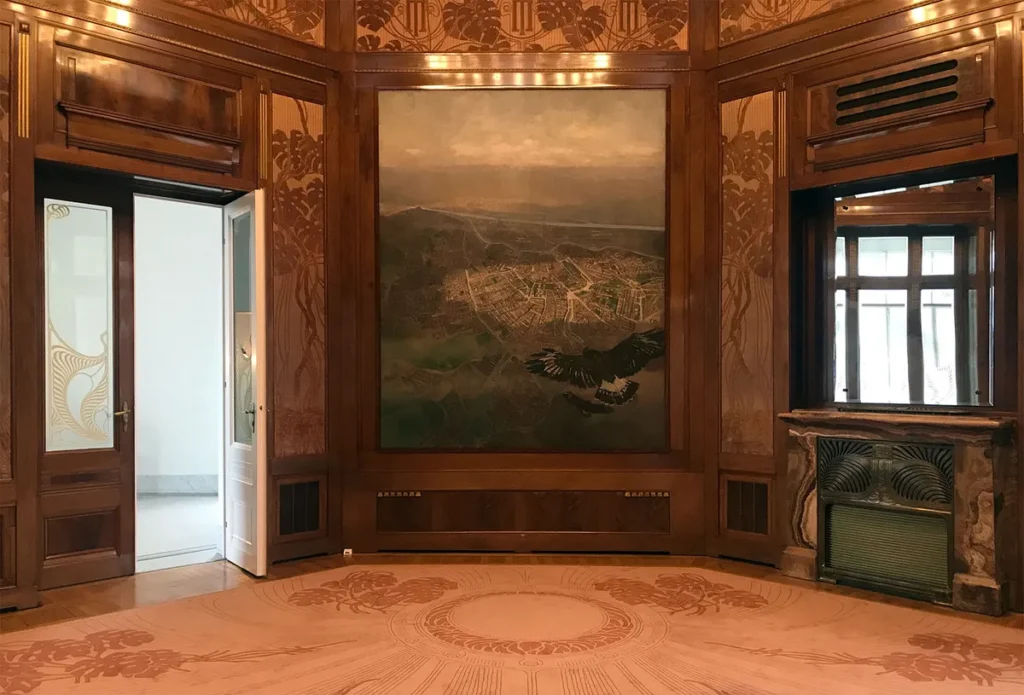
There is also a smaller waiting room, a study equipped with a desk, and two staircases (now closed) that led down to the station platforms. Some of the original designs for the building can be found inside, where a wealth of information in both German and English is available.
Franz Joseph first used the station in June 1899 on a trip to inspect the new metro line, and a report in the Neue Freie Presse noted that he was “especially pleased” with the pavilion. However, his enthusiasm was limited. His second (and last) visit didn’t come until April 1902 and, despite his efforts, Wagner never received an Imperial commission. But the pavilion was no Habsburg folly. It proved popular and was described by Ver Sacrum, the magazine of the Vienna Secession, as “a glorious and, one may well hope, consequential victory [for Modernism] in a field in which it has hitherto been a stranger.”
The pavilion was refurbished in 2014 and restored to its appearance when it first opened and is now a branch of the Wien Museum.